

Features
Dashboard Reporting

Generate AI Before & After Reports

Solutions
Dashboard Reporting

Generate AI Before & After Reports

AI EmployeesBuild Your AgentFeaturesAI Templates
Resources
Connections

Combine your stack

Task Answers

Answers with insights

Datasets

Data and charts

Glossary

Definitions made simple

Tools

Optimize Faster with AI

Blog

Insights that make SEO measurable.

Link Four
Link FiveLink SixLink Seven
Sign InBook a Demo Call
Sign InGet Free Trial
HomeBlogProductSpotRise ResearchKeyword Research

AI Content Optimization Tools: How to Create Content That Ranks Across Google, AI Overviews, and LLM Search

Content optimization has moved beyond keyword density and word count. AI tools now decode the full spectrum of what search engines reward — from semantic completeness and entity coverage to AI Overview citation patterns. This guide covers how the leading platforms work, what they cost, and how to integrate them into a workflow that produces consistent ranking results across both traditional and AI-powered search

Author:

Daniel Ostrovski, Head of Content at SpotRise

Date Published:

February 14, 2026

The New Economics of Content That Ranks

Content creation for search has undergone a structural transformation. The era of keyword stuffing ended years ago, and even the more sophisticated approach of writing comprehensive long-form content around target keywords is no longer sufficient to guarantee visibility. Search engines now evaluate content through multiple lenses simultaneously: topical completeness, semantic relevance, information architecture, user engagement signals, entity recognition, and the degree to which content satisfies the specific intent behind a query. On top of this, the rise of AI-powered search has added an entirely new layer of complexity — content must now be optimized not just for traditional blue-link rankings, but for citation in AI Overviews, ChatGPT responses, and Perplexity answers.

The scale of this challenge is reflected in the market. The AI-powered SEO software market reached $3.98 billion in 2025 and is projected to grow to $32.6 billion by 2035 at a compound annual growth rate of 23.4%, according to Coherent Market Insights. Within this broader category, AI content creation and optimization tools represent one of the fastest-growing segments, with the market expected to reach $7.22 billion by 2029 at a 19.8% CAGR. These numbers reflect the reality that content optimization has become too complex for manual approaches to handle at scale.

Adoption data tells the same story from the practitioner side. According to multiple industry surveys conducted in 2025, 86% of SEO professionals have integrated AI into their strategies, with 58% specifically using AI for content ideation and optimization. Among enterprise teams, 82% plan to increase their AI investments in SEO during 2026. The results justify the investment: organizations using AI-driven content optimization report a 45% increase in organic traffic and a 38% improvement in conversion rates on average. AI tools can improve SEO rankings by up to 49.2%, and companies implementing AI for content optimization see a 30% ranking improvement within six months.

Yet despite this widespread adoption, a significant gap exists between teams that use AI content optimization tools effectively and those that treat them as a checkbox exercise. The tool provides data and guidance; the competitive advantage comes from understanding how to interpret that guidance, when to follow it, and when to deviate in favor of originality and editorial judgment.

How AI Content Optimization Tools Actually Work

At their core, AI content optimization tools reverse-engineer what makes top-ranking content successful and translate those patterns into actionable guidance for writers. The process involves several analytical layers working in concert, each powered by natural language processing models that have become dramatically more sophisticated over the past two years.

SERP Analysis and Competitor Modeling

The tool begins by analyzing the current search results for your target keyword. It crawls and analyzes the top 10 to 20 ranking pages, examining their word count, heading structure, subtopic coverage, keyword usage patterns, entity mentions, readability metrics, and content format. This analysis creates a competitive benchmark that represents what search engines currently consider high-quality content for that specific query.

What distinguishes AI-powered analysis from manual competitor research is the depth and speed of pattern recognition. A human researcher might notice that all top-ranking pages include a section about pricing or that most use comparison tables. The AI identifies hundreds of these patterns simultaneously, including subtle semantic relationships between concepts that correlate with higher rankings but would escape manual observation. Tools like Surfer SEO analyze over 500 on-page signals per SERP, while Clearscope uses IBM Watson-level NLP to map the conceptual territory that top-ranking content occupies.

Semantic Gap Identification

Once the competitive landscape is mapped, the tool identifies semantic gaps — topics, subtopics, entities, and concepts that top-ranking content consistently covers but that your draft currently lacks. These gaps represent opportunities to improve your content’s completeness and relevance without simply copying competitor approaches.

Advanced tools go beyond simple keyword matching to identify conceptual gaps. For example, if you are writing about email marketing platforms, the tool might identify that top-ranking content consistently discusses deliverability testing, CAN-SPAM compliance, and integration with CRM systems — not as keywords to insert but as conceptual areas that your content should address to be considered comprehensive. MarketMuse’s AI takes this further by building personalized topic models for your specific domain, calculating a unique difficulty score that reflects your site’s existing authority on related topics rather than using a generic industry-wide metric.

Real-Time Content Scoring

As you write or edit, the optimization tool provides a real-time score that reflects how well your content aligns with the competitive benchmark. This score typically combines multiple dimensions: keyword coverage, semantic completeness, readability, heading structure optimization, content length, and entity presence. The score updates dynamically as you make changes, providing immediate feedback on whether edits improve or diminish the content’s competitive positioning.

Different tools approach scoring differently. Clearscope uses an A-through-F grading system that many teams find intuitive for content quality assessments. Surfer SEO provides a numerical content score from 0 to 100 with granular term-by-term tracking. MarketMuse scores content against its personalized topic model rather than just SERP competitors. Frase combines research, writing, and optimization scoring in a single interface. Rankability uses a dual-engine approach combining IBM Watson and Google NLP for its scoring algorithm, producing what the company describes as higher accuracy through cross-validation of two independent language models.

The value of real-time scoring is that it keeps the optimization process integrated with the creative process rather than treating them as separate stages. Writers see the impact of their editorial decisions immediately and can make informed trade-offs between stylistic preferences and search optimization goals.

The AI Content Optimization Tool Landscape: A Practical Comparison

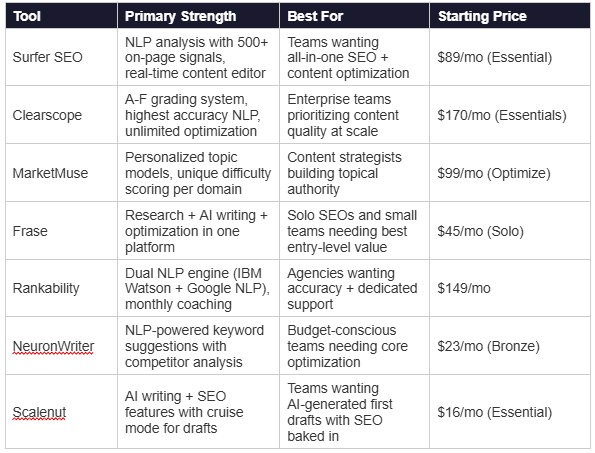
The market for content optimization platforms has matured significantly. Each tool has carved out a distinct positioning, and understanding their strengths helps you select the right platform for your team’s needs and budget.

The pricing spectrum reveals a clear segmentation. Entry-level tools like Scalenut and NeuronWriter serve solo practitioners and small teams at $16–$45 per month. Mid-range platforms like Surfer SEO and MarketMuse target growing teams at $89–$99 per month, with full feature sets available at $219–$499 per month. Enterprise-grade solutions like Clearscope start at $170 per month, with custom plans for large organizations running at $189 or more per seat with unlimited content optimization. Rankability occupies a premium niche at $149 per month, differentiating through its dual-engine NLP approach and included coaching calls.

The critical distinction between these tools is not just features but methodology. Surfer SEO functions as a comprehensive on-page optimization platform that includes keyword research, site audits, and content editing within a single ecosystem. Clearscope focuses exclusively on content optimization with the highest accuracy NLP, making it the preferred choice for teams that already have separate SEO tools. MarketMuse uniquely personalizes its recommendations to your domain’s existing authority, which matters enormously for sites building topical clusters. Frase combines research, AI writing, and optimization in one streamlined workflow that is particularly effective for smaller teams.

Essential Features That Separate Good Tools From Great Ones

Intent-Aligned Keyword Recommendations

Not all keyword recommendations are created equal. The best AI tools distinguish between informational, commercial, and transactional intent signals and recommend keywords that align with the specific intent your content is designed to serve. A product comparison page should emphasize commercial intent keywords, while an educational guide should prioritize informational terms. Tools that treat all keywords equally, regardless of intent alignment, produce content that confuses both search engines and readers.

This capability has become more important as Google’s algorithms have grown more sophisticated at matching search intent. According to industry data, 52% of SEO professionals have noticed measurable performance improvement specifically from AI-powered on-page SEO, and intent alignment is a significant driver of that improvement. Content that precisely matches the search intent behind a query consistently outperforms content that covers the topic broadly but misses the specific angle users are looking for.

Heading Structure Optimization

Content structure plays a crucial role in both search engine understanding and user experience. AI tools analyze how successful competitors structure their headings and recommend an optimal heading hierarchy. This includes suggestions for H2 and H3 topics that ensure comprehensive coverage, logical flow recommendations that improve readability, and identification of missing structural elements that competitors consistently include.

Strong heading optimization goes beyond keyword insertion into headings. It considers the information architecture of the page, ensuring that the heading structure creates a clear, scannable outline that allows both search engine crawlers and human readers to quickly understand the scope and organization of the content. With 13.08% of top-performing Google content now AI-generated — up from just 2.3% in the pre-GPT era — having a well-structured, comprehensive heading hierarchy has become table stakes for competitive content.

Content Freshness and Update Recommendations

Search engines increasingly favor content that demonstrates currency and ongoing maintenance. AI content optimization tools track the freshness of your existing content relative to competitors and flag pages that have become outdated. More importantly, they provide specific update recommendations: which sections need new data, where competitor content has advanced beyond your current coverage, and which trending subtopics should be added to maintain or improve rankings.

This capability transforms content optimization from a one-time publishing task into an ongoing maintenance discipline. Pages that were optimized six months ago may have lost competitive ground as new content enters the landscape. AI tools ensure that your content library remains competitive over time, not just at the moment of publication. For teams managing hundreds or thousands of pages, this automated freshness monitoring is the difference between a content library that compounds in value and one that gradually decays.

Multi-Platform Optimization: Beyond Traditional Search

This is the most significant shift in content optimization for 2026. With AI-powered search experiences now handling a substantial share of information queries, content optimization can no longer focus exclusively on Google’s traditional algorithm. Google’s AI Overviews appeared in 13.14% of US desktop searches in March 2025, more than doubling from 6.49% in January of the same year. ChatGPT now serves over 800 million weekly users processing more than one billion daily queries, commanding 68% of the AI chatbot market. Perplexity processes 780 million monthly queries with 239% year-over-year growth.

JPMorgan Chase has predicted a 25% decline in traditional search traffic by end of 2026, and yet only 47% of brands have implemented Generative Engine Optimization strategies. This gap represents both a risk and a massive opportunity for content teams that optimize proactively.

The data shows that content ranking number one on a traditional SERP has a 33.07% chance of being cited in AI Overviews, compared to just 13.04% for content at position ten. Furthermore, 46% of documents referenced in AI Overviews come from the top organic search results. Strategic content modifications — including structured data, clear entity definitions, direct answer formatting, and comprehensive topical coverage — can increase AI visibility by up to 40%. Modern content optimization tools are beginning to incorporate these signals, scoring content not just for traditional ranking potential but for its likelihood of being cited by AI systems.

Integrating AI Content Optimization Into Your Workflow

The Brief-to-Publication Pipeline

The most effective content teams integrate AI optimization at every stage of the content lifecycle. The process begins with keyword research and topic selection, where the tool helps identify high-opportunity topics with achievable difficulty levels. Next, the tool generates a content brief that includes recommended word count, heading structure, key subtopics to cover, and semantic keywords to incorporate. Tools like Surfer SEO and MarketMuse can generate comprehensive content briefs automatically, while Frase combines brief generation with built-in AI writing assistance.

During the writing phase, the AI provides real-time optimization guidance. Writers see their content score update as they work, with specific suggestions for improving coverage of key topics. The integration with familiar writing environments matters here: Surfer SEO offers plugins for Google Docs and WordPress, Clearscope integrates with Google Docs and WordPress, and most other tools provide browser-based editors that support copy-paste workflows.

After the initial draft is complete, the tool highlights remaining gaps and provides specific revision recommendations. Finally, before publication, the tool validates that all optimization criteria are met and the content is competitive with current top-ranking results. This end-to-end pipeline is what allows teams to save up to 50% of time on content analysis and production, according to multiple industry reports.

Balancing AI Guidance With Editorial Voice

A critical skill in using AI content optimization tools is knowing when to follow their recommendations and when to deviate. The tool’s guidance is based on statistical patterns in successful content, but not every pattern is worth replicating. If every top-ranking page for your keyword includes a particular section, the tool will recommend it, but there may be strategic reasons to take a different approach that differentiates your content.

The most successful content teams treat AI optimization scores as one input among several. They aim for a high but not necessarily perfect score, understanding that a score of 85 out of 100 paired with genuinely original insights and a distinctive voice will outperform a score of 98 achieved through mechanical adherence to competitor patterns. According to research from multiple sources, 67% of marketers report improvement in content quality when using AI tools — but that improvement comes from teams that use AI as an enhancement to human creativity, not a substitute for it.

Measuring Content Optimization Impact

Quantifying the return on your investment in AI content optimization tools requires tracking specific metrics against historical baselines and non-optimized content.

  • Time-to-rank. How quickly does new optimized content reach target positions? AI-optimized content should consistently reach page one faster than non-optimized content. Companies report a 30% ranking improvement within six months of implementing AI content optimization.
  • Ranking stability. Track whether optimized content maintains positions over time rather than spiking and declining. Well-optimized content with comprehensive topical coverage tends to be more resilient to algorithm updates.
  • Organic traffic per page. Compare against non-optimized content on similar topics. AI-driven content campaigns report an average 45% increase in organic traffic, though results vary significantly by competition level.
  • Conversion rate. Verify that optimization improvements translate into business outcomes. Revenue increases from AI-powered SEO range from 3–15%, with sales ROI uplift averaging 10–20% according to McKinsey research.
  • Content score trends. Monitor how your content scores evolve relative to competitors over time. A declining score on a previously optimized page signals the need for a refresh.
  • AI search visibility. Track whether your optimized content is being cited in AI Overviews, ChatGPT responses, and Perplexity answers. This is an emerging but increasingly critical metric.

This measurement discipline is essential for justifying the ongoing investment in optimization tools and for refining your workflow based on what produces the best results for your specific domain and audience. The 75% of marketers who report using AI to reduce time on manual SEO tasks are reinvesting those saved hours into strategic analysis, creative content development, and performance measurement — activities that AI cannot fully automate.

Common Mistakes in AI-Assisted Content Optimization

AI tools accelerate content optimization, but they also accelerate mistakes when used without strategic thinking. Here are the most common pitfalls and how to avoid them.

  • Treating the score as the goal. The most prevalent mistake is treating the optimization score as the primary objective rather than a secondary indicator. Content that scores perfectly by mechanically including every recommended term but reads like a keyword-stuffed checklist will not succeed with readers or search engines. The score should guide your writing, not dictate it. Aim for 80–90% optimization with genuine editorial substance rather than 100% mechanical compliance.
  • Optimizing pages in isolation. Each piece of content exists within a larger topical ecosystem on your site. Optimizing individual pages without considering how they relate to other pages in the same topic cluster can lead to cannibalization, where multiple pages compete for the same queries. Tools like MarketMuse address this by modeling your entire content inventory, but teams using other tools need to maintain their own cluster strategy.
  • Neglecting re-optimization over time. Search results are dynamic: competitors publish new content, algorithms evolve, and user expectations shift. Content that was fully optimized at publication gradually loses competitive edge. Conduct quarterly content health checks across your most important pages using your AI optimization tool.
  • Ignoring AI search optimization. With only 47% of brands having GEO strategies despite AI search handling billions of queries, teams that optimize exclusively for traditional rankings are missing a growing share of visibility. Ensure your content includes clear entity definitions, structured data, and direct-answer formatting that AI systems can easily cite.
  • Choosing tools based on price alone. A $16 per month tool and a $170 per month tool serve fundamentally different needs. The cheapest option may lack the NLP accuracy, integration ecosystem, or content brief capabilities that your workflow requires. Evaluate tools based on methodology fit, not just feature lists and pricing.
  • Over-relying on AI-generated content without optimization. With 13.08% of top-performing content now AI-generated, many teams are producing AI drafts but skipping the optimization step. AI-written content still needs to be optimized against SERP competitors, refined for readability, and enriched with original insights that differentiate it from the growing volume of generic AI output.

The Evolution of AI Content Optimization

The next generation of content optimization tools is evolving in several directions that will reshape how content teams work.

Multi-Modal Content Optimization

As search engines become better at understanding images, videos, interactive elements, and audio content, optimization tools are expanding their analysis beyond text. A future-ready optimization tool already recommends adding comparison tables, embedding relevant videos, or including interactive calculators based on what performs best in search results for your target topic. With video content increasing sharing potential by 40% and interactive tools earning passive links over time, multi-modal optimization is becoming essential for competitive content.

Personalization and Audience Segmentation

As AI search becomes more conversational and user-specific, content optimization will need to account for audience segmentation. The same topic might require different optimization approaches depending on whether the primary audience is technical professionals, executive decision-makers, or early-career practitioners. MarketMuse has led this direction with its personalized topic modeling, and other tools are beginning to incorporate audience persona signals into their optimization recommendations.

Predictive Ranking Models

Current tools tell you how your content compares to what currently ranks. Next-generation tools will predict how content will perform before publication, estimating time-to-rank, traffic potential, and probability of AI search citation based on your domain’s authority, the competitive landscape, and historical performance patterns. This predictive capability will transform content strategy from reactive optimization to proactive planning, allowing teams to allocate resources to the topics and formats with the highest expected return.

Continuous Optimization Agents

The most significant near-term development is the emergence of AI agents that continuously monitor and update content without manual intervention. Rather than requiring quarterly human-driven content audits, these agents track ranking changes, competitor content updates, and algorithm shifts in real time, automatically flagging content that needs attention and even generating specific update recommendations. SpotRise’s AI agents exemplify this approach, connecting content optimization data with technical SEO, rank tracking, and reporting within a unified system that keeps your entire content library competitive.

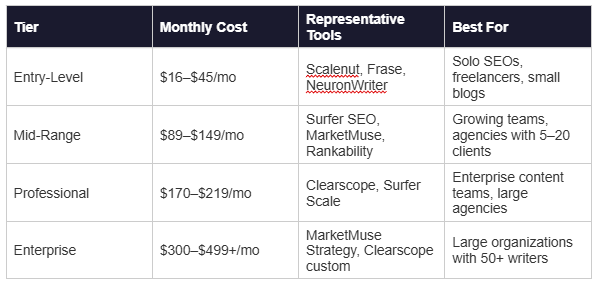
Pricing Benchmarks: What Content Optimization Tools Cost in 2026

Understanding the pricing landscape helps teams budget appropriately and evaluate ROI. Here are the current pricing tiers across the major platforms.

The ROI calculation is straightforward. A mid-range tool at $100 per month that saves a content team 10–15 hours of manual SERP analysis and optimization work each month effectively costs $6–10 per hour saved — far less than the hourly cost of an SEO specialist or content strategist. When that same tool improves average ranking positions and drives measurable traffic increases, the return compounds significantly. Teams that track content optimization ROI consistently report that the tool pays for itself within the first month through time savings alone, with ranking and traffic improvements providing additional returns over time.

────────────────────────────────────────────────────────────

Ready to Optimize Content That Ranks Everywhere?

Every hour spent manually analyzing competitor content, counting keyword occurrences, and guessing at semantic gaps is an hour not spent on creating genuinely valuable, differentiated content. In 2026, with AI search handling billions of queries, content competition intensifying across every niche, and the bar for ranking quality rising continuously, the ability to optimize efficiently and comprehensively is not optional — it is the foundation of content-driven growth.

SpotRise helps SEO teams and freelancers automate content optimization alongside their entire SEO workflow: from connecting your existing tools to running AI-powered content audits, monitoring ranking changes, tracking AI search visibility, and generating reports that connect content performance to business outcomes — no code, no manual spreadsheets, no missed optimization opportunities.

‍

Read More

Read More Articles You Might Like

February 14, 2026

10 min

Best AI SEO Tools for Agencies in 2026: How to Automate 80% of Your Workflow and Scale Without Hiring

AI SEO automation, SEO agency tools 2026, AI agents for SEO, GEO tools for agencies, automated SEO reporting

Read Article

February 14, 2026

10 min

AI Link Building Tools: How to Automate Outreach, Earn High-Quality Backlinks, and Scale Your Off-Page SEO

Link building remains the most time-consuming and expensive area of SEO — with average costs reaching $500+ per quality backlink and outreach response rates stuck below 9%. AI tools are changing the economics. This guide covers how AI automates prospecting, personalizes outreach, protects your backlink profile, and integrates with your entire SEO workflow.

Read Article
Share: Copied!

Tired of the routine for 50+ clients?

Your new AI assistant will handle monitoring, audits, and reports. Free up your team for strategy, not for manually digging through GA4 and GSC. Let us show you how to give your specialists 10+ hours back every week.

Book a Demo

SpotRise shows where your brand appears in AI tools—so you can stand out, get traffic, and grow faster.

Resources
Task AnswersDatasetsGlossaryToolsBlogSEO AI Agent
Social Media
Instagram
Twitter / X
LinkedIn
Threads
Reddit
© 2025 SpotRise. All rights reserved.
Terms of ServicePrivacy Policy
Start Automating 80% of Your SEO

Just write your commands, and AI agents will do the work for you.

Book a Demo