

Features
Dashboard Reporting

Generate AI Before & After Reports

Solutions
Dashboard Reporting

Generate AI Before & After Reports

AI EmployeesBuild Your AgentFeaturesAI Templates
Resources
Connections

Combine your stack

Task Answers

Answers with insights

Datasets

Data and charts

Glossary

Definitions made simple

Tools

Optimize Faster with AI

Blog

Insights that make SEO measurable.

Link Four
Link FiveLink SixLink Seven
Sign InBook a Demo Call
Sign InGet Free Trial
HomeBlogProductAnalyticsSpotRise ResearchLink Building

AI Link Building Tools: How to Automate Outreach, Earn High-Quality Backlinks, and Scale Your Off-Page SEO

Link building remains the most time-consuming and expensive area of SEO — with average costs reaching $500+ per quality backlink and outreach response rates stuck below 9%. AI tools are changing the economics. This guide covers how AI automates prospecting, personalizes outreach, protects your backlink profile, and integrates with your entire SEO workflow.

Author:

Daniel Ostrovski, Head of Content at SpotRise

Date Published:

February 14, 2026

Updated for February 2026. Includes real data from 500+ SEO professionals, tool comparisons, pricing benchmarks, and actionable workflows.

The Link Building Paradox: Why It Is Still SEO’s Most Expensive Bottleneck

Link building has occupied a peculiar position in the SEO world for over a decade. Every practitioner agrees it matters: pages ranking in Google’s top position have an average of 3.8 times more backlinks than those in positions two through ten, according to Backlinko’s ranking factors study. A staggering 94% of all content published online earns zero external links, which means the small minority of pages that do attract backlinks hold a dramatic competitive advantage. And yet, despite this consensus on importance, link building remains the single most dreaded task in the SEO profession.

In a 2025 survey of 518 SEO professionals conducted by Editorial.Link, 52.3% identified link building as the most challenging aspect of SEO. Conductor’s research puts the number even higher among enterprise teams: 41% of large companies say link building provides the most value of any SEO activity, but the same percentage says it is the most difficult to execute. The reason is simple — link building is a high-volume activity that demands high-quality, personalized execution. Sending hundreds of outreach emails is necessary to earn a meaningful number of links, but generic templates produce response rates below 9%. This tension between scale and quality is the core paradox that has made link building simultaneously indispensable and unsustainable for most teams.

The economics tell the story clearly. The average cost of a single high-quality backlink now sits at approximately $500, according to converging data from Ahrefs, BuzzStream, Siege Media, and uSERP. For earned links through digital PR campaigns, costs routinely climb to $1,000–1,500 per placement. In competitive verticals like finance, legal, gambling, and SaaS, a single backlink from a DR 70+ domain can exceed $2,500. Agencies allocate roughly 32% of their entire SEO budget to link building, and in-house teams invest even more at 36% on average. Monthly campaign budgets for competitive niches typically range from $5,000 to $25,000, and 80.9% of SEO professionals believe these costs will continue rising over the next two to three years.

These numbers represent a massive operational burden, particularly for agencies managing multiple client accounts simultaneously. A link building specialist alone costs $40,000–80,000 annually in salary. Add content creators, designers, tool subscriptions, and outreach infrastructure, and the overhead for running link building in-house can reach $18,000–35,000 per month before a single link is placed. This is where AI enters the picture — not as a silver bullet, but as a fundamental shift in the economics and execution of link building.

What AI Actually Changes About Link Building

AI’s impact on link building is best understood through the lens of what makes link building expensive: human time spent on repetitive, research-intensive tasks. Prospecting for relevant domains, evaluating their quality, finding contact information, writing personalized outreach emails, managing follow-up sequences, and monitoring results — these activities consume the vast majority of a link builder’s day, and they are precisely the tasks where AI delivers the most leverage.

According to a study cited by Grand View Research, organizations using AI-assisted link building workflows have reduced their outreach cost per link by 35%, increased the average Domain Rating of acquired links by 29%, and identified risky domains 2.1 times faster compared to non-AI workflows. These improvements are not marginal. They represent the difference between a link building operation that bleeds money and one that generates measurable ROI.

It is important to be specific about what AI does and does not do well in this context. AI excels at pattern recognition across large datasets, natural language generation for personalized outreach, classification of domains by relevance and quality, and automation of multi-step workflows that would otherwise require constant human attention. What AI does not do well — at least not yet — is replace the strategic judgment, relationship-building, and creative problem-solving that separate good link builders from great ones. The most effective approach treats AI as an accelerator for human expertise, not a replacement for it.

The Five Core Capabilities of AI Link Building Tools

Modern AI link building platforms generally combine five capabilities that, together, transform the economics of the discipline.

  • Intelligent prospect discovery. AI analyzes your content, identifies its topical context, and surfaces websites most likely to link based on their existing linking patterns, content focus, and audience overlap — going far beyond simple Domain Authority filters.
  • Automated contact enrichment. Once prospects are identified, AI tools locate the right decision-maker (editor, content manager, webmaster), extract verified email addresses, and pull relevant social profiles for multi-channel outreach.
  • Personalization at scale. AI reads each prospect’s recent articles, identifies relevant talking points, and generates outreach messages that reference specific content — producing the kind of personalization that would take a human 15–20 minutes per email, but in seconds.
  • Intelligent follow-up management. AI manages follow-up sequences, adjusting timing and messaging based on recipient behavior. A single follow-up can increase response rates from 8.5% to 14.1% — a 65.8% improvement.
  • Continuous backlink monitoring. AI tracks your entire backlink profile, alerting you when high-value links are removed, new referring domains appear, or toxic patterns emerge that could trigger algorithmic penalties.

AI-Powered Prospect Discovery: From Days to Minutes

Traditional link building prospecting is a grind. You search for relevant sites, check their Domain Rating, evaluate content quality, look at their linking history, assess audience overlap, and determine whether they are likely to respond to outreach. For a single campaign targeting 200 prospects, this process easily consumes two to five full working days. Multiply that across multiple clients or campaigns, and prospecting alone can absorb 40–60% of a link builder’s productive time.

AI transforms this bottleneck in two fundamental ways. First, it dramatically accelerates the mechanics of research by scanning thousands of domains simultaneously and applying multi-factor quality filters in seconds. Second — and more importantly — it improves the quality of prospect selection by evaluating signals that human researchers either miss or do not have time to check.

Beyond Domain Authority: Contextual Relevance Scoring

The most sophisticated AI prospecting tools have moved well beyond simple metric-based filtering. While Domain Rating and Domain Authority remain useful directional signals, 84.6% of SEO professionals now cite topical relevance as the most critical factor in backlink quality, according to Editorial.Link’s 2025 survey. AI tools address this by evaluating contextual relevance at the page and domain level.

Modern AI prospecting evaluates whether a site regularly covers topics related to your content, whether it has linked to similar resources in the past, whether its audience demographics align with yours, the recency and quality of its publishing activity, its organic traffic patterns and growth trajectory, and whether it shows signs of being part of a private blog network or link farm. These qualitative signals are what separate a link that drives real referral traffic and authority from a link that simply exists as a number in your backlink profile.

Competitive Gap Analysis at Scale

One of the most powerful applications of AI in prospecting is competitive backlink gap analysis. AI tools continuously monitor where your competitors earn new links, identify patterns in their acquisition strategy, and surface domains that link to multiple competitors but not to you. These “gap” domains represent the highest-probability outreach targets because they have already demonstrated a willingness to link to content in your space. According to research from Aira, 54% of businesses already generate link prospects through competitor analysis and link targeting, and AI makes this process both faster and more comprehensive.

Personalization at Scale: Solving Outreach’s Fundamental Tension

Outreach is the make-or-break moment of any link building campaign, and the data paints a sobering picture of current performance. The average outreach email achieves a response rate of just 8.5%. Personalizing the subject line alone can boost response rates by up to 30.5%, and personalized outreach beats templated emails at a ratio of three-to-one in conversion. Yet most teams cannot afford the time required for genuine personalization when running campaigns at scale.

Consider the math. If personalizing a single outreach email takes 15 minutes of research and writing, a campaign targeting 300 prospects requires 75 hours of outreach work alone — nearly two full working weeks for one person. Even a small agency managing ten concurrent link building campaigns would need a dedicated team of four to five people just for outreach composition, before factoring in follow-ups, tracking, and reporting.

How AI Personalization Actually Works

AI outreach tools analyze each prospect’s online presence — their recent articles, the topics they cover, their writing style, their social media activity — and use these signals to generate messages that are genuinely specific to the recipient. This is not about inserting a first name into a template. Tools like Respona, Postaga, and BacklinkGPT produce outreach that references a specific article the prospect published, acknowledges a particular insight or data point they shared, explains why your content adds value to their existing coverage, and suggests a specific placement that makes editorial sense.

The result is outreach that reads like it was written by someone who actually studied the prospect’s work — because, in effect, the AI did exactly that. The response rate improvement is significant: according to PressWhizz’s analysis of 2025–2026 data, personalized AI outreach consistently outperforms manual templates by two to three times in reply rate, while reducing per-email composition time from 15–20 minutes to under 30 seconds.

Multi-Channel Outreach: Beyond Email

Email remains the primary communication channel for link building, used by 45.1% of link builders as their main outreach method. However, the landscape is shifting. LinkedIn is now used by 17.3% of SEOs for link building outreach and has emerged as the most effective platform for reaching decision-makers, particularly in B2B and SaaS. LinkedIn InMail response rates range from 10–25%, making it two to five times more effective than cold email for certain prospect segments. Multi-channel outreach combining email, LinkedIn, and phone has been shown to boost results by 287% compared to single-channel approaches.

AI tools are beginning to coordinate outreach across these channels, creating unified sequences where a LinkedIn connection request precedes an email pitch, or where social engagement warms up a prospect before the formal outreach arrives. This orchestration is extremely difficult to manage manually but becomes straightforward with AI-driven workflow automation.

The Outreach Timing and Cadence Playbook

AI tools also optimize when and how often to reach out. Data from large-scale outreach studies reveals specific patterns that AI can exploit systematically.

Wednesday has the highest average response rate for outreach emails at 7.64%, followed by Thursday at 7.60%. Saturday is the worst day, with just 5.65%. The average response time from prospects is 12.85 hours, with over half of all replies arriving within six hours and nine out of ten within two days. The optimal number of follow-ups is one to two: a single follow-up increases response rates from 8.5% to 14.1%, while excessive follow-ups generate diminishing returns and risk damaging your sender reputation.

AI outreach tools encode these patterns automatically, scheduling initial sends for optimal days and times, triggering follow-ups at data-driven intervals, and stopping sequences when a recipient replies. Human link builders can certainly learn these best practices, but consistently executing them across hundreds of prospects and multiple campaigns simultaneously is where AI delivers an operational advantage that manual processes cannot match.

Backlink Profile Monitoring and Protection

Building links is only half the equation. Protecting the links you have is equally important, and it is a dimension of link building that most teams neglect until damage has already occurred.

Consider these realities: 66.5% of links to sites built over the last nine years are now defunct, according to Ahrefs’ link decay research. High-value links can be removed without notice when sites restructure their content, change ownership, or simply update old articles. Toxic links from spam networks or negative SEO attacks can appear at any time, potentially triggering algorithmic penalties that wipe out months of ranking progress.

What AI Monitoring Detects

AI-powered backlink monitoring tools track your entire link profile continuously and alert you to critical changes. SpotRise’s AI agents, for example, include backlink monitoring capabilities that detect lost backlinks from high-authority domains so you can re-engage before the ranking impact compounds, track new referring domains and evaluate whether they strengthen or weaken your profile, identify toxic link patterns such as sudden spikes in low-quality domains or unnatural anchor text distributions, and monitor competitor backlink acquisition to identify new opportunities for your own campaigns.

This continuous monitoring replaces the traditional approach of periodically downloading backlink reports and manually reviewing them — a process that is both time-consuming and reactive by nature. When a DR 80 backlink disappears, the difference between noticing it in 24 hours and noticing it in 30 days can represent significant ranking and traffic loss.

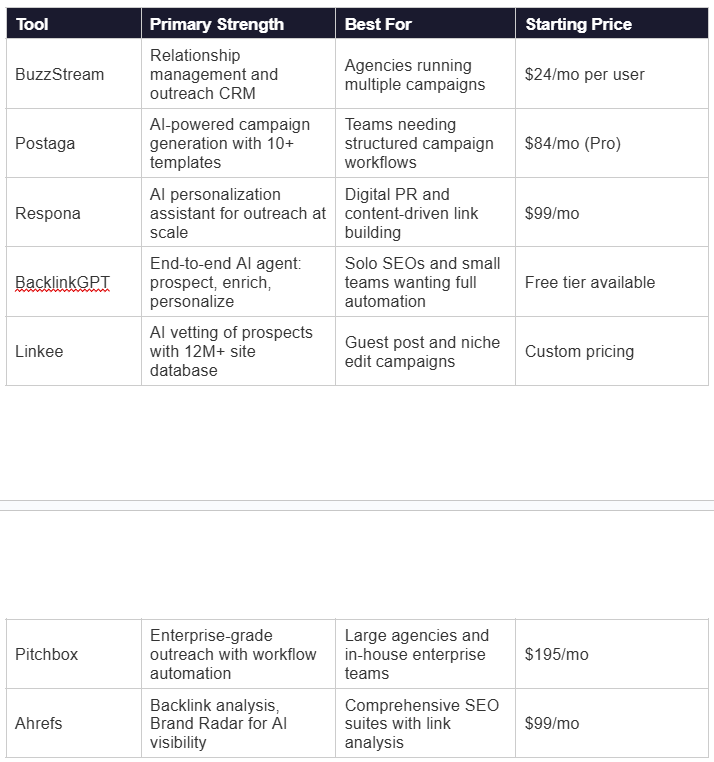
The AI Link Building Tool Landscape: A Practical Comparison

The market for AI-assisted link building tools has matured rapidly. Each platform addresses different parts of the workflow, and understanding their strengths helps you build the right stack for your operation.

No single platform covers every aspect of AI link building perfectly. The most effective stacks typically combine a prospecting and analysis tool like Ahrefs or Semrush with a dedicated outreach platform like BuzzStream, Postaga, or Respona, and a monitoring layer that provides continuous backlink health tracking. SpotRise fits into this ecosystem by providing the AI agent layer that connects these tools, automates workflows between them, and delivers unified reporting to stakeholders.

Digital PR and AI: The New Link Building Power Couple

The most significant trend in link building over the past two years is the ascent of digital PR as the dominant strategy. In Editorial.Link’s 2025 survey, 48.6% of SEO professionals rated digital PR as the most effective link building tactic, surpassing guest posting for the second consecutive year. This shift has profound implications for how AI tools are being deployed.

Digital PR link building earns backlinks by creating newsworthy content — original research, data studies, expert commentary, interactive tools — and pitching it to journalists and publications. Unlike traditional link building, which often involves negotiating placements on existing pages, digital PR generates editorial coverage that naturally includes backlinks. These links carry exceptional authority because they come from established publications with genuine editorial oversight.

How AI Enhances Digital PR Campaigns

AI enhances every phase of a digital PR campaign. During ideation, AI analyzes trending topics, media coverage patterns, and content gaps to identify angles with the highest newsworthiness potential. According to BuzzStream’s research, 94.8% of successful digital PR campaigns use data-led content, and AI can rapidly identify datasets, survey angles, and statistical stories that are likely to attract journalistic attention.

During outreach, AI tools build targeted media lists by analyzing journalists’ beat coverage, recent articles, and social activity. The 56.1% of digital PR practitioners who cited BuzzStream as their top outreach tool are increasingly using its AI features to match story pitches with the journalists most likely to cover them.

After publication, AI monitors coverage, tracks earned backlinks, and identifies follow-on opportunities where the same story can be pitched from a different angle to additional outlets. This continuous cycle of creation, outreach, monitoring, and iteration is where AI transforms digital PR from a series of one-off campaigns into a systematic, compounding link acquisition engine.

Content Formats That Earn the Most Links in 2026

Not all content earns links equally. AI tools can analyze your competitive landscape and identify which formats perform best in your specific niche, but broad industry data provides a useful starting point for content strategy.

Long-form content exceeding 3,000 words generates approximately 3.5 times more backlinks than shorter articles, likely because comprehensive resources serve as definitive references that other creators cite. The top three content formats for attracting backlinks are “Why” posts, “What” posts, and infographics, which collectively attract 25.8% more referring links than other formats.

Original research and data studies are the gold standard for digital PR link building, with over 90% of successful campaigns incorporating data-led content. Interactive tools, calculators, and templates earn passive links over time because they provide ongoing utility. Video content increases sharing potential by 40%, and podcast guest appearances create backlink opportunities through show notes and episode pages.

AI tools like Surfer AI can analyze which content formats earn the most links in your specific industry, eliminating guesswork from your content creation priorities. When you know that original research outperforms listicles by four-to-one in link acquisition within your niche, you can allocate resources accordingly.

Backlinks and AI Search: The New Frontier

A critical development that most link building guides overlook is the growing connection between backlinks and visibility in AI-powered search. According to Editorial.Link’s 2025 survey, 73.2% of SEO professionals believe backlinks influence a brand’s chance of appearing in AI search results from platforms like ChatGPT, Perplexity, and Google’s AI Overviews.

This belief is supported by emerging evidence. Referring domains and backlinks show a measurable correlation with appearing in AI Overviews, according to BuzzStream’s analysis, although branded web mentions appear to carry even more weight. The mechanism makes intuitive sense: AI language models are trained on web data, and sites with strong backlink profiles from authoritative sources appear more frequently and prominently in training corpora, making them more likely to be cited in AI-generated responses.

This means that link building in 2026 serves a dual purpose. Traditional links still drive rankings in conventional search results, where 65% of users continue to click on organic blue links according to Backlinko. But those same links — particularly from high-authority, editorially rigorous sources — also strengthen your brand’s entity recognition in AI systems, increasing the probability of being cited when users ask AI assistants questions in your domain.

Ahrefs’ Brand Radar tool reflects this shift, tracking brand mentions across AI-generated search results and highlighting which domains are cited by LLMs. This gives link builders a clear list of authoritative targets for outreach campaigns designed to improve both traditional and AI search visibility simultaneously.

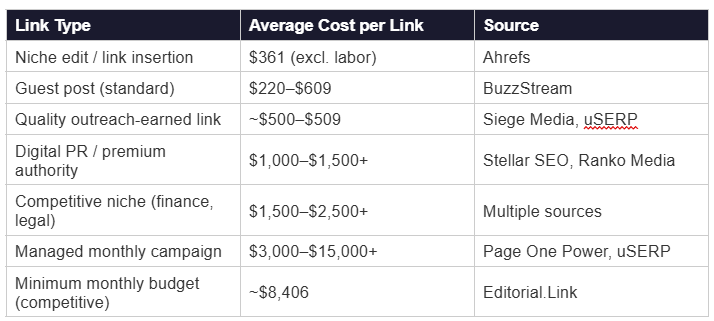
Link Building Pricing Benchmarks for 2026

Understanding current pricing helps you budget effectively and evaluate whether AI tools are delivering genuine cost savings. Here are the key benchmarks based on converging data from multiple industry studies.

The key insight from these benchmarks is that AI’s 35% reduction in cost per link translates to substantial savings at scale. For an agency spending $10,000 per month on link building, AI-assisted workflows could save $3,500 monthly — $42,000 annually — while potentially improving the quality of acquired links through better prospect selection and more effective personalization.

Building an AI-Integrated Link Building Workflow

The maximum value of AI in link building emerges when it is integrated into your broader SEO workflow rather than deployed as an isolated set of tools. Here is a practical workflow that connects content creation, link building, and performance monitoring into a continuous cycle.

Phase 1: Content Creation and Link Opportunity Mapping

When your content team begins developing a new asset, AI tools should simultaneously analyze the competitive landscape for that topic, identifying who links to similar content, what content formats earn the most links in that niche, and which prospects represent the highest-probability outreach targets. This analysis should inform content creation decisions: if original data studies earn four times more links than opinion pieces in your industry, that insight should shape what gets produced.

Phase 2: Automated Prospect Discovery and Enrichment

As soon as content is published, AI triggers automated prospecting. The system identifies relevant domains from competitive backlink data and topical relevance analysis, finds decision-maker contact information through email and LinkedIn enrichment, scores prospects by probability of response based on historical patterns, and prioritizes outreach targets by expected link quality and ranking impact.

Phase 3: Personalized Outreach at Scale

AI generates personalized outreach messages for each prospect, referencing their recent content and explaining why linking to your asset benefits their audience. Messages are scheduled for optimal send times, and follow-up sequences are pre-configured with adaptive timing and messaging. Human review of high-priority outreach ensures quality control on the most valuable prospects.

Phase 4: Monitoring, Reporting, and Iteration

As links are acquired, AI tracks their impact on rankings and organic traffic, monitors for link loss or toxicity issues, and reports results to stakeholders. The system feeds performance data back into prospecting algorithms, improving future targeting based on which prospect profiles and outreach approaches actually converted.

Platforms like SpotRise enable this integration by connecting content creation, technical SEO, rank tracking, and link monitoring within a unified system. AI agents can trigger link building campaigns automatically when new content is published, monitor ranking changes as links are acquired, and deliver reports that connect link building activity to business outcomes — not just SEO metrics.

Common Mistakes in AI Link Building (and How to Avoid Them)

AI tools accelerate link building, but they also accelerate mistakes when used carelessly. Here are the most common pitfalls and how to avoid them.

  • Treating AI as a spam machine. The goal of AI personalization is to create genuinely relevant outreach, not to blast more emails faster. Teams that use AI primarily to increase volume without maintaining quality will see declining response rates, damaged sender reputation, and potential blacklisting. AI should produce better outreach at higher volume, not just more of the same.
  • Over-relying on Domain Rating as a quality signal. A DR 50 site with 40,000 organic visits and genuine editorial content is worth far more than a DR 50 site with 300 visits and a history of selling guest posts. AI tools should evaluate traffic, content quality, linking patterns, and editorial standards — not just a single metric.
  • Ignoring link decay. With 66.5% of links decaying over time, failing to monitor and protect existing links means your backlink profile is shrinking even as you build new ones. AI monitoring should be a non-negotiable component of any link building program.
  • Skipping human review on high-value prospects. AI can generate excellent outreach for the long tail of prospects, but your top 10–20% of targets — the high-authority publications, the industry leaders, the journalists with major platforms — deserve human-crafted messages that reflect genuine relationship-building intent.
  • Operating link building in isolation. Link building works best when connected to content strategy, technical SEO, and business objectives. AI makes this integration easier, but it requires intentional setup. A link building campaign that earns backlinks to content that does not rank for relevant keywords wastes resources on both fronts.
  • Neglecting AI search signals. As AI-powered search grows, failing to track whether your brand appears in AI Overviews and LLM responses means missing an increasingly important dimension of link building ROI. Tools like Ahrefs Brand Radar make this tracking accessible.

Key Metrics for Measuring Link Building ROI

AI tools generate data, but knowing which metrics actually matter for evaluating link building performance separates strategic programs from busy ones. According to research from multiple sources, 53% of SEOs use keyword rankings as their primary measure of link building success, but the most sophisticated programs track a broader set of indicators.

  • Cost per acquired link. The total spend (tools, labor, content) divided by links earned. AI should reduce this over time. Track the trend, not just the absolute number.
  • Response and conversion rates. Track reply rates across different outreach templates, channels, and prospect segments. AI enables granular A/B testing at scale.
  • Referring domain growth. Monitor net new referring domains month-over-month, accounting for both gains and losses from link decay.
  • Link quality distribution. Track the Domain Rating and organic traffic of linking sites. An upward trend in average link quality indicates improving targeting.
  • Ranking impact. Connect new backlinks to ranking changes for target keywords. AI monitoring can attribute ranking movements to specific link acquisitions.
  • Organic traffic from linked pages. The ultimate measure: are the pages receiving backlinks driving more organic traffic and conversions?
  • AI search visibility. Track brand mentions and citations in AI-generated search results as an emerging KPI for off-page SEO effectiveness.

The Future of AI in Link Building

The trajectory of AI in link building points toward increasingly autonomous workflows. Current tools handle prospecting, personalization, and monitoring. Near-future developments will likely include predictive link valuation models that estimate the ranking impact of a specific link before it is acquired, enabling more precise resource allocation. We will see deeper integration between content creation and link building, where AI simultaneously produces linkable content assets and identifies prospects for them. Autonomous campaign management will emerge, where AI agents run end-to-end link building programs with human oversight limited to strategy setting and quality approval. Finally, real-time adaptation to algorithm updates will become standard, where AI detects shifts in how search engines evaluate links and adjusts acquisition strategies accordingly.

For agencies and in-house teams, the strategic implication is clear: the competitive advantage in link building is shifting from labor capacity to intelligence infrastructure. The teams that build the most effective AI-assisted workflows today will compound their advantage as these tools become more capable.

────────────────────────────────────────────────────────────

Ready to Automate Your Link Building Workflow?

Every hour spent manually prospecting for domains, composing templated outreach emails, and downloading backlink reports is an hour not spent on strategy, creative content development, and client relationships. In 2026, with link building costs rising, outreach competition intensifying, and AI search visibility becoming a critical new dimension, the ability to operate efficiently is not a luxury — it is a competitive requirement.

SpotRise helps SEO teams and freelancers put link building on autopilot: from connecting your existing tools to triggering AI-powered prospecting, monitoring your backlink health, and generating reports that tie link building to business outcomes — no code, no hours of manual research, no missed opportunities.

Read More

Read More Articles You Might Like

February 14, 2026

10 min

Best AI SEO Tools for Agencies in 2026: How to Automate 80% of Your Workflow and Scale Without Hiring

AI SEO automation, SEO agency tools 2026, AI agents for SEO, GEO tools for agencies, automated SEO reporting

Read Article

February 14, 2026

10 min

AI Content Optimization Tools: How to Create Content That Ranks Across Google, AI Overviews, and LLM Search

Content optimization has moved beyond keyword density and word count. AI tools now decode the full spectrum of what search engines reward — from semantic completeness and entity coverage to AI Overview citation patterns. This guide covers how the leading platforms work, what they cost, and how to integrate them into a workflow that produces consistent ranking results across both traditional and AI-powered search

Read Article
Share: Copied!

Tired of the routine for 50+ clients?

Your new AI assistant will handle monitoring, audits, and reports. Free up your team for strategy, not for manually digging through GA4 and GSC. Let us show you how to give your specialists 10+ hours back every week.

Book a Demo

SpotRise shows where your brand appears in AI tools—so you can stand out, get traffic, and grow faster.

Resources
Task AnswersDatasetsGlossaryToolsBlogSEO AI Agent
Social Media
Instagram
Twitter / X
LinkedIn
Threads
Reddit
© 2025 SpotRise. All rights reserved.
Terms of ServicePrivacy Policy
Start Automating 80% of Your SEO

Just write your commands, and AI agents will do the work for you.

Book a Demo